Ehran wrote:its exactly the same principle that a blast furnace works on.
You don't actually know how a blast furnace works do you?
read this:
http://www.steel.org/learning/howmade/blast_furnace.htmA blast furnace is able to reach steel melting temperatures by a series of special chemical reactions combined with, critically, the use of intense air pressure:
Large volumes of air, from 80,000 ft3/min to 230,000 ft3/min, are generated from a turbo blower and flow through the "cold blast main" (14) up to the stoves. This cold blast then enters the stove that has been previously heated and the heat stored in the refractory brick inside the stove is transferred to the "cold blast" to form "hot blast".
There is no such source of air pressure in a building fire whatsoever.
Lets examine another photo:
[img]
http://911research.wtc7.net/wtc/evidenc ... crash2.jpg
[/img]
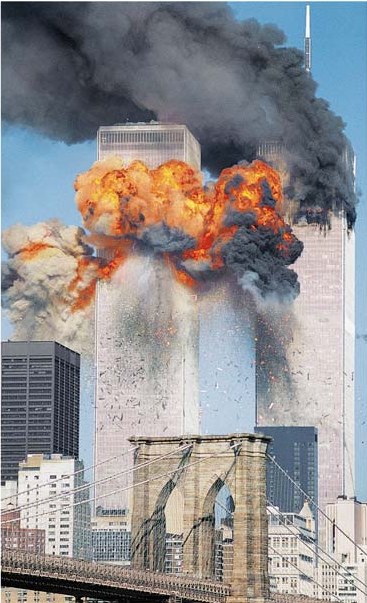
Here we see the second impact explosion and the fire from the first.
Lets talk about the fire on the right first, one that officials claim melted steel. One can hardly even see any flames, especially in the impact hole. You may think that because there is a lot of smoke there is a big fire, but that is not true. A fire that burns efficiently (one that is very hot) produces no smoke (like the jet fuel explosion of the left). But even a small fire produces a lot of smoke if it isn't burning well, if it is relatively cool/starved for oxygen. It is simply impossible for the fire we see to melt steel.
The fire we see on the left is the explosion of jet fuel escaping into the atmosphere. It is burning hot and cleanly (but still not hot enough to melt steel even considering the pressure of the explosion.) The duration of the explosion would be the time when the WTC steel beams would be hottest. And yet the towers withstood the explosions, suddenly collapsing an hour or more after.
Whatever made the WTC towers fall it wasn't the fires. Anyone using science can see the official explanation is bull.
 Posted: Sat May 01, 2004 7:59 pm